For many people the ultimate goal of seismology is to predict earthquakes. I find it interesting that almost every seismology textbook I have read devotes its final chapter to earthquake prediction. It almost makes sense that predicting earthquakes is what seismologists should eventually be able to do – yet it is unfortunate, and quite embarrassing, that earthquake prediction is actually what seismologists are the worst at.
So why are earthquakes so difficult to predict?
First, we should define what the term earthquake prediction means; that is, correct earthquake prediction. A prediction is considered “successful” when it provides an accurate assessment of at least three parameters: the time, the place, and the magnitude of the earthquake. Predictions usually fall under three categories:
- Long-term: made years in advance
- Intermediate-term: made weeks in advance
- Short-term: made hours to seconds in advance.
In this post, we will focus in long-term predictions. Long-term predictions are important because they can affect urban planning and result in programs that can prevent or mitigate the effects of earthquakes, mainly through building reinforcements.
Seismologists have a fairly good idea where future earthquakes are more likely to occur. Looking at a global map of seismicity (Figure 1), we easily observe that earthquakes do not occur at random places around the world, but they follow a fairly systematic spatial distribution – most earthquakes occur along the boundaries between the Earth’s surface plates.
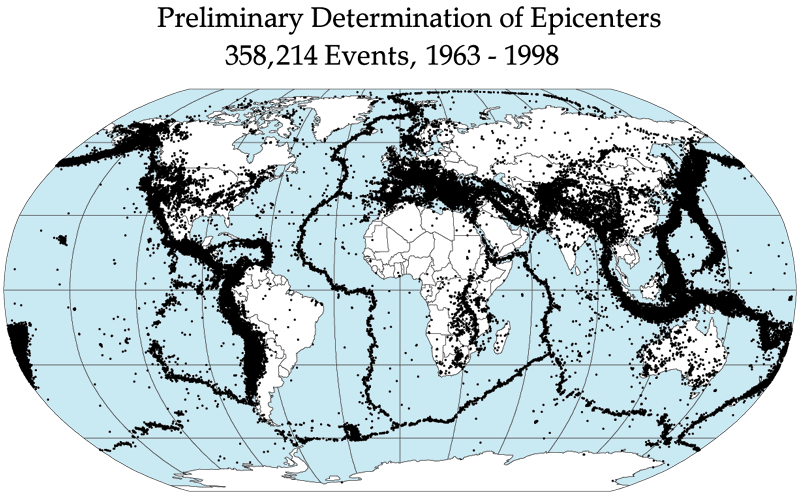
Figure 1. Map of global seismicity [source]
Scientists also have a good understanding of how the magnitudes of earthquakes vary. For example, it has been long known that the largest earthquakes occur in subduction zones (regions where one tectonic plate is moving underneath another), such as the east coast of Japan and the west coast of South America. In fact, the largest earthquakes since 1900 have been subduction-zone earthquakes, the largest being the magnitude-9.5 1960 Chile earthquake. However, earthquakes that occur in other types of geologic settings have lower magnitudes. For example, earthquakes occurring on strike-slip faults (regions where one tectonic plate is moving past another), such as the San Andreas Fault in California and the North Anatolian Fault in Turkey, have significantly lower magnitudes, usually in the range of 7 to 8.
The most difficult aspect of earthquake prediction is predicting the timing of future earthquakes. In general, the more periodic a natural phenomenon is, the more predictable it is. For example, 400 years of recorded observations of the Sun reveal that the solar cycle (the variation in the amount of solar radiation that hits the Earth) varies very consistently with an average period of about 11 years. When it comes to earthquakes, however, the recorded history is so small that it is almost impossible to make any statistical arguments as to whether earthquakes exhibit periodic or chaotic behaviors. Since 1900, great earthquakes (magnitude 9 and higher) appear to have happened in two clusters: the first one during a 10-year period in the 1950s and 1960s, and a very recent one that includes the 2004 Sumatra and the 2011 Japan earthquakes. Do earthquakes occur in clusters? Do large earthquakes trigger other earthquakes? These are just a couple of the many questions that make earthquake prediction an extremely challenging problem.
There are cases, however, where earthquakes appear to occur at fairly regular intervals. In these cases, long-term prediction may be possible, although the exact timing of the next earthquake would still be unknown.
A classic example of such “predictable” earthquake behavior is the segment of the San Andreas Fault at Parkfield, California, where magnitude-5.5 and higher earthquakes occurred in 1857, 1881, 1901, 1922, 1934, and 1966; i.e., with a fairly consistent 22-year average recurrence interval. This pattern led the U.S. National Earthquake Prediction Evaluation Council to “predict” in 1984 that a magnitude-6 earthquake would occur before 1993 (Figure 2). That earthquake did occur, but not until 2004. Clearly, some of the assumptions made in that prediction were wrong. For example, the recurrence interval hypothesis isolates a given fault segment and ignores interactions with other faults. Real fault systems involve not just single faults, but entire collections of interacting faults. In general, for certain fault segments, the average recurrence interval may be well defined, but significant fluctuations occur.
Figure 2. "Predicting" the Parkfield earthquake [source]
In summary, while we can expect where future earthquakes will occur and approximately how big they will be, predicting the exact timing of a single future earthquake is an extremely difficult, if not impossible, task. With such a complicated system and so limited recorded observations, it is still impossible to make well-reasoned predictions.
Perhaps seismology's ultimate goal to society is not to predict when exactly the next "big one" will occur. At least for now, the most direct benefits that society gains from seismology are through identifying the regions most at risk of great earthquakes, and promoting the appropriate engineering of earthquake-resistant structures, in order to minimize the death toll when the next big earthquake does happen.
Selected references
- Lay T., and Wallace T.C. (1995) Modern Global Seismology. Academic Press
- Shearer, P.M. (2009) Introduction to Seismology. Cambridge University Press


